
How to create the perfect pattern for your feet.
Finding the Perfect Fit
Mass-produced shoes are made based on an average last, meaning it’s often difficult to find a pair that perfectly fits your own feet.
At LOPER, you can easily adjust the shoe pattern during the upper-making process to match the unique shape of your feet. This allows you to create truly custom shoes with a high level of comfort and fit.
About Material Thickness
When using soft leather, a thickness of around 2mm is recommended.
For firmer materials, a thickness of about 1.5mm is ideal.
Cutting Direction of Leather
Animal hides have both stretchy and non-stretchy directions.
If the leather stretches too much while walking, it can cause discomfort.
To prevent this, be mindful of the cutting direction and cut the leather so that it resists stretching, as shown in the diagram.

Treating the Back Side of the Leather
In conventional leather shoes, lining is often applied inside the upper.
However, LOPER shoes are made from a single piece of leather, and the leathers we use are already properly thinned and treated on the back side.
If you use untreated leather, apply a product like Tokonole to press down and smooth the fibers on the back (the fuzzy side).
This simple step will greatly improve the quality of the finished shoes.
Fit and Sizing
When your shoes are newly finished, it’s best if they feel snug or even slightly tight.
As you wear them, the leather will gradually stretch and mold to your feet for a perfect fit.
Many people are tempted to choose soft leather, thinking it will be gentle on their feet—but if the leather stretches too much, it can actually make walking more difficult.
Unless you have specific foot concerns such as hallux valgus (bunions) or ingrown nails, we recommend choosing firm leather.
It may feel stiff at first, but over time it will soften and become a durable pair that you can enjoy for many years.
Choosing the Right Sole Size
Remove your shoes and place your bare or socked foot on the sole.
For styles such as Derby, Macalon, and Plain, which have a relatively flat toe area, the correct size is one that leaves about 1.5–2cm of space at the toes when your heel is aligned with the back of the sole.
However, styles like Sneakers or Loafers have different internal structures and may feel slightly larger even if the size label is the same.
For these models, choosing one size smaller than usual is recommended.
During pattern adjustment, select the instep and heel parts that best match each of your feet.

When adjusting the pattern, the instep and heel parts are chosen to fit each foot.
Fitting Notes
The Derby, Macalon, Plain, and Sneaker-A models share the same sizing.
However, due to structural differences, Sneakers, Hi Tops, and Loafers may fit slightly differently.
If you’re considering these models, we recommend preparing fitting samples for each design to ensure the best fit.
Instep parts

Back Parts
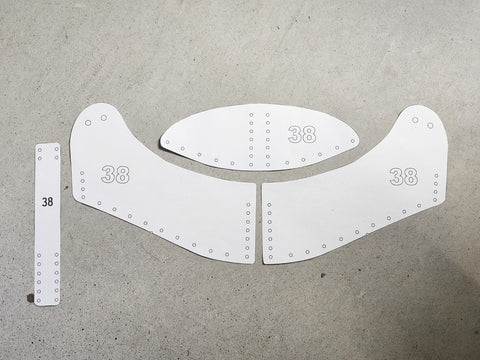
Instep and Heel Parts
For High Insteps
People with high insteps often choose shoe sizes based on height of the instep, which can leave too much space at the toes.
This not only makes walking uncomfortable but can also make the shoes look disproportionately large.
At LOPER, we solve this by selecting the sole according to foot length, and then adjusting the upper pattern (instep area) for a beautiful, custom fit.
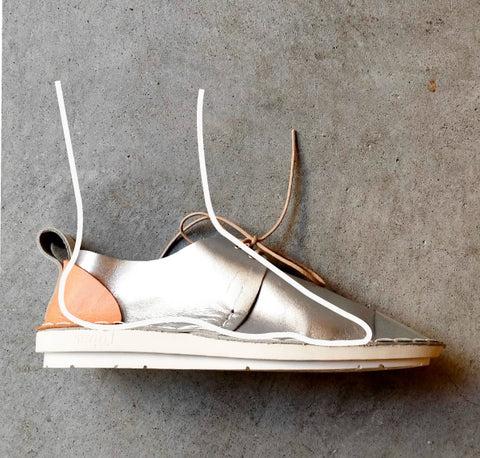
For example, if your foot length matches size 37/38 but size 39 feels just right when worn,
you can use a size 38 sole and expand the instep pattern to size 39 for the perfect balance.
To do this, prepare both the 38 and 39 instep patterns, and combine them as follows:
-
Cut open the center of the size 38 instep pattern.
-
Widen it to match the width of size 39.
-
Fix it in place with tape.
When adjusting the instep pattern, remember to widen the facing (eyelet piece) by the same amount.
This ensures the upper doesn’t open too widely after completion and maintains a beautiful silhouette.


Fix with tape.

For High Instep but Small Heel
Some people have a high instep yet a small heel.
In such cases, you can make the heel pattern smaller while keeping the instep pattern larger, then fine-tune the facing piece to maintain overall balance.
This results in a shoe that fits securely and comfortably.

Combining Patterns Across Models
The Derby model has a separate instep and heel structure, while models like Plain or Macalon do not.
However, by cutting along the dotted line, you can easily separate and recombine parts — allowing the same adjustment methods to be applied across designs.
This technique lets you improve fit consistency even between different shoe models.


In the case of a low instep


For Low Instep
People with low insteps often find that shoes fitting their foot length feel loose on top.
When they try a smaller size, the instep fits but the toes feel cramped.
In such cases:
-
Choose the heel part one size smaller.
-
Adjust the instep pattern by narrowing it (the opposite of the high-instep adjustment).
Cut the pattern slightly and narrow it to match the smaller size, then tape it to secure.

Cut the pattern down to this size, and then make the pattern smaller by one size.

Fix it with tape and you're done.

Partial Fit Adjustments
If the instep fits well but the heel feels loose, adjust only the heel pattern.
If the heel fits perfectly but the instep feels loose, adjust only the instep.
If you have any questions or feedback, please don’t hesitate to reach out.